Will the Nepal Stock Exchange rally after the 2026 elections? Discover historical NEPSE trends, average post-election gains of 14%, and expert technical analysis for investors.
In the world of the Nepal Stock Exchange (NEPSE), history doesn’t just repeat—it often rallies. As the nation prepares for the general election on March 5, 2026, a familiar ‘election fever’ has gripped the secondary market. Historically, the conclusion of a general election in Nepal acts as a massive psychological trigger, often leading to double-digit gains within just 60 days.
But is the current market setup ready for another historic jump, or will political fragmentation stall the momentum? In this analysis, we dive into the data from 2008 to 2022 to predict exactly what investors can expect from NEPSE in the coming weeks.
Here is an analysis of how the stock market typically behaves after an election, what the data shows, and what investors can expect this time around.
1. The Historical “Election Jump.”
Data from past elections shows a clear trend: the market almost always rewards the conclusion of an election in the short term. Looking at the two-month window following previous polls, NEPSE has shown resilience and growth:
- 2008 Election: The market saw a significant gain of 22.5% in the two months following the results.
- 2013 Election: This period recorded a massive 32.5% rally.
- 2022 Election: Despite a more subdued economy, the market still climbed by 12% in the following 60 days.
- The Average Trend: On average, the NEPSE index has gained approximately 14.3% in the two months post-election across historical data points.
2. Short-Term vs. Long-Term Outlook
While the short-term “bounce” is statistically likely, the long-term trajectory depends entirely on the nature of the government formed.
- The Stability Factor: The market’s biggest enemy is political instability. Since no single party has crossed the 50% majority threshold in recent history, Nepal has been stuck in a cycle of “revolving door” coalition governments. This leads to frequent policy changes that hamper long-term investor confidence.
- The “Liberal” Hope: Currently, investors are closely watching parties with liberal economic agendas. Historically, when the market perceives a new government as “pro-business” or focused on economic reform, we see a shift from a sideways market to a full-blown bull run.
3. Current Market Sentiment (2026 Context)
The lead-up to the March 5 election has already triggered a pre-election rally.
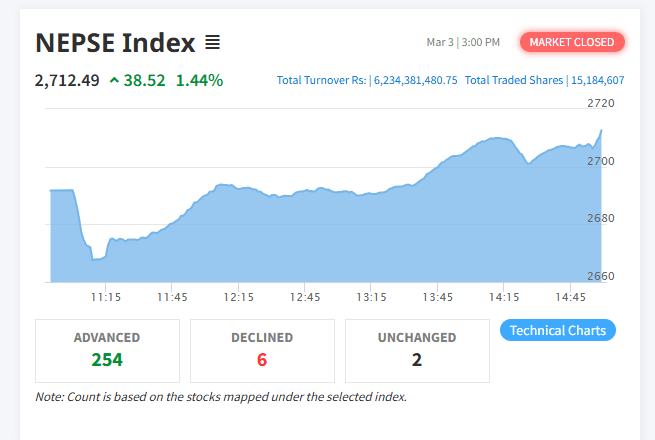
- Pre-Election Gains: In the final trading days before the polls, NEPSE surged by over 38 points, with daily turnovers crossing 6 billion NPR.
- Investor Psychology: Much of the current momentum is driven by “election optimism.” Investors are betting that the incoming leadership will address long-standing demands, such as increasing margin lending and allowing non-resident Nepalis (NRNs) to participate in the secondary market.
4. Technical Analysis: Is History Repeating?
Technically, the current NEPSE chart mirrors the setup seen in 2022. Before that election, the market was consolidating in a “demand zone” (a price level where buyers typically step in).
- The Opportunity: If the index follows the 2022 pattern, we could see a strong “V-shaped” recovery immediately following the announcement of results.
- Key Levels: Analysts suggest that if NEPSE can break and sustain above the 2,730 level post-election, it would signal a strong bullish bias for the remainder of the year.
5. Strategy for Investors
If you are looking to trade the election wave, consider these three pillars:
- Don’t Ignore Fundamentals: While “hype” can drive prices up in the short term, long-term wealth is built on companies with strong earnings. Avoid “herd mentality” often seen on social media platforms.
- Watch the “Policy Signal”: The first 30 days of a new government are crucial. Watch for the appointment of the Finance Minister and any early statements regarding capital market reforms.
- Prepare for Volatility: Elections bring “unanticipated events.” While a win for a market-friendly coalition could spark a rally, a fragmented or disputed result could lead to a sharp, albeit temporary, correction.
Conclusion
History suggests that the post-election period is one of the most profitable windows for NEPSE investors. However, the real prize isn’t just a 14% short-term gain—it’s the hope of long-term political stability that could finally trigger a sustained bull market in Nepal.
Read Latest Post By Hemantakc.com.np:
- How the 2082 Election Manifestos Could Shake the NEPSE (March 4, 2026)
- Prabhu Insurance (PRIN) Announces 9.15% Dividend for FY 2081/82 (March 3, 2026)
- Beni Hydropower IPO Details and How to Apply (February 28, 2026)
- NEPSE Margin Trading Guide: Rules, Eligibility & Risks in Nepal (February 27, 2026)
- How to Open a DEMAT Account Online in Nepal (2026 Guide) (February 26, 2026)
FAQs
Does the NEPSE index always go up after an election?
While not “guaranteed,” history shows a strong bullish bias. On average, NEPSE has gained approximately 14.3% in the two months following the last three major elections (2008, 2013, and 2022). The 2013 election saw the highest surge of 32.5%.
Why does the stock market rally after elections in Nepal?

The rally is usually driven by “election optimism” and the end of political uncertainty. Investors often bet that a new government will introduce market-friendly policies, increase liquidity, and focus on economic stability. Additionally, increased government spending during elections often trickles into the financial system.
Which sectors perform best after a general election?
Based on recent trends in 2026, the Life Insurance, Hotels & Tourism, and Manufacturing sectors have shown the strongest momentum. Historically, the Banking and Hydropower sectors also see significant volume as investors look for stability and long-term dividend potential.
What is the “Election Jump” in NEPSE?
The “Election Jump” refers to a short-term price surge (usually lasting 30–60 days) that occurs immediately after the election results are announced. For example, in the lead-up to the March 5, 2026, election, NEPSE already saw a pre-election spike of 38.52 points on the final trading day.
Should I buy stocks before or after the election results?
Buying before the election (pre-election rally) allows you to capture the initial surge, but it comes with higher political risk. Conservative investors often wait for the official result and the appointment of the Finance Minister to confirm if the new government’s policies will be market-friendly before committing large capital.
Will the 2026 election trigger a permanent Bull Market?
While elections provide a short-term boost, a long-term bull market (reaching targets like 3,200 or 4,000 points) depends on structural reforms. Investors are currently watching for changes in margin lending rules and the potential entry of Non-Resident Nepalis (NRNs) into the secondary market.