KATHMANDU – The latest semi-annual report from Nepal Rastra Bank for the fiscal year 2082/83 reads like a tale of two countries. On paper, Nepal has never looked more secure; in the streets and kitchens of Kathmandu, the story is far more complicated.
The data reveals a striking contradiction: while the central bank’s vaults are overflowing with foreign currency, the “foundation” of the nation—its farms and small businesses—is quietly shivering.
The “Full” Vault vs. The Struggling Farm
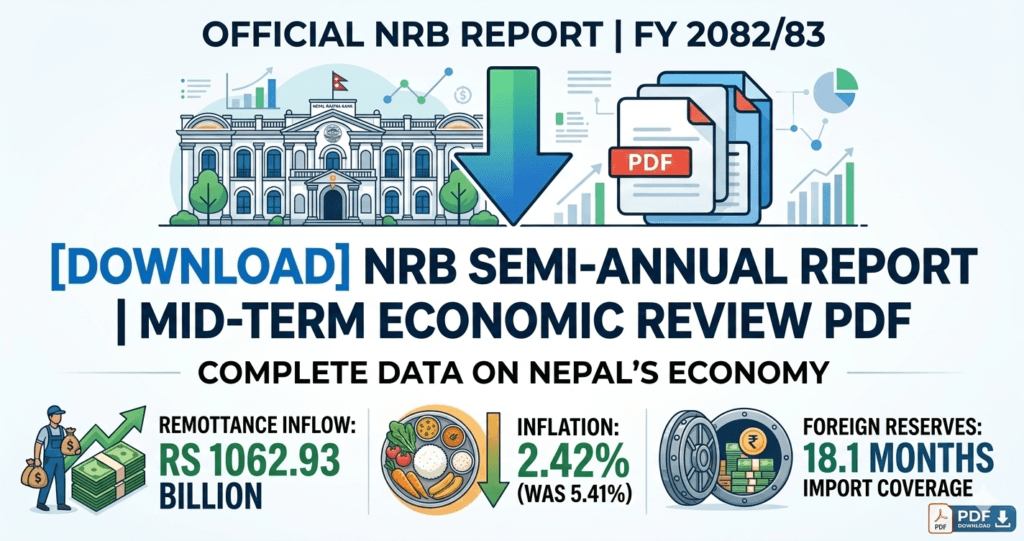
In a milestone for the country’s external stability, Nepal now holds enough foreign exchange to cover roughly 18 and a half months of imports. This is a massive safety net, yet it highlights a growing problem. The country is sitting on a mountain of cash it either cannot or will not spend on its own growth.
Most concerning is the 1.2% decline in agricultural credit. While policy speeches often prioritize the “plow and the soil,” banks are actually pulling back their investments from the farming sector. In the long run, this suggests a future where Nepal may become even more dependent on imported food, despite having the funds to prevent it.
The Kitchen Table Reality
Inflation numbers look excellent on a spreadsheet, dropping to 2.42% from last year’s 5.41%. In fact, the report suggests food and beverage prices have technically “deflated” by 0.09%.
However, for the average family, this isn’t necessarily a cause for celebration. Experts wonder if prices for staples like pulses (down 5.52%) and spices (down 3.92%) are falling because of a production boom, or simply because people no longer have the “purchasing power” to buy them.
Meanwhile, the “middle-class squeeze” remains tight:
- Education costs: Up 7.56%
- Clothing and Footwear: Up 5.29%
Luxury for the Few, Debt for the Many
The report hints at a growing wealth gap. While agricultural loans are drying up, luxury vehicle loans (hire purchase) have surged by 7.15%. Even with gold prices skyrocketing by 72.6% globally, imports of gold and silver in Nepal continue to rise.
Money is flowing into the country, but it is increasingly concentrated in unproductive sectors or tucked away by a limited group, rather than fueling jobs or factories.
The High Cost of the “Remittance Lifeline”
Remittances remain the country’s heartbeat, with Rs 1,062.93 billion flowing in over just six months. But this “lifeline” comes with a heavy human price tag.
- Labor migration: Re-employment permits rose by 19%, totaling nearly 200,000 people.
- Education “Exit”: Rs 67.47 billion left the country in just six months as students headed abroad.
Nepal is essentially trading its youngest, brightest minds for cash—an exchange that keeps the economy afloat today but threatens the brain trust of tomorrow.
A Lack of Confidence
Perhaps the most telling statistic is the “lazy money” sitting in banks. Deposits have grown by 14.8%, but credit flow—the money actually being borrowed to start businesses or expand shops—is only at 6.7%.
Even with average interest rates dropping to a very low 7.12%, the private sector isn’t biting. The money is there, and it’s cheap, but the confidence to invest in Nepal’s immediate future is missing.
Latest:
- NEPSE After Election: Historical Data & 2026 Market Predictions
- How the 2082 Election Manifestos Could Shake the NEPSE
- Prabhu Insurance (PRIN) Announces 9.15% Dividend for FY 2081/82
- Beni Hydropower IPO Details and How to Apply (February 28, 2026)
- NEPSE Margin Trading Guide: Rules, Eligibility & Risks in Nepal
- How to Open a DEMAT Account Online in Nepal (2026 Guide)